High-Fidelity Architecture
A comprehensive technical deep-dive into the sovereign engine: **3-Layer Separation of Concerns**, **Axum/Tokio Async Execution**, **Sapphire Shield Governance**, and **LanceDB GraphRAG Memory**.
Sovereign Protocol Core Stack
Click any component below to inspect runtime specs, data flows, and code contracts.
Operational Perspectives
Select a role to see how AI-Tadpole-OS transforms security, governance, EBITDA protection, and daily execution.
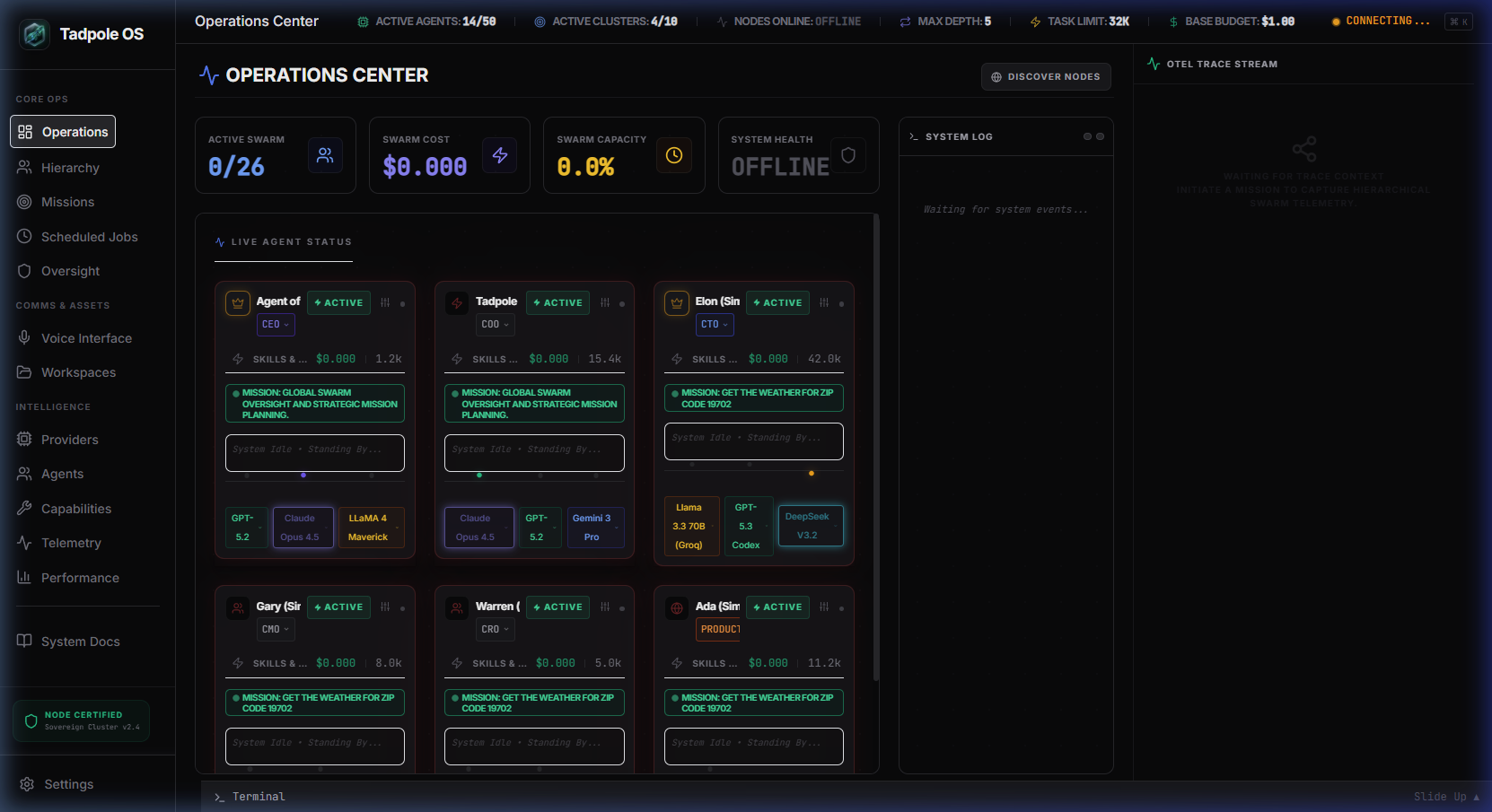
Air-Gapped Local Security & Merkle Audits
IT departments maintain 100% control over execution boundaries. All external network access can be disabled via the **Hard Privacy Gate**, while every single tool call generates an immutable Merkle-tree audit receipt logged in SQLite + LanceDB storage.
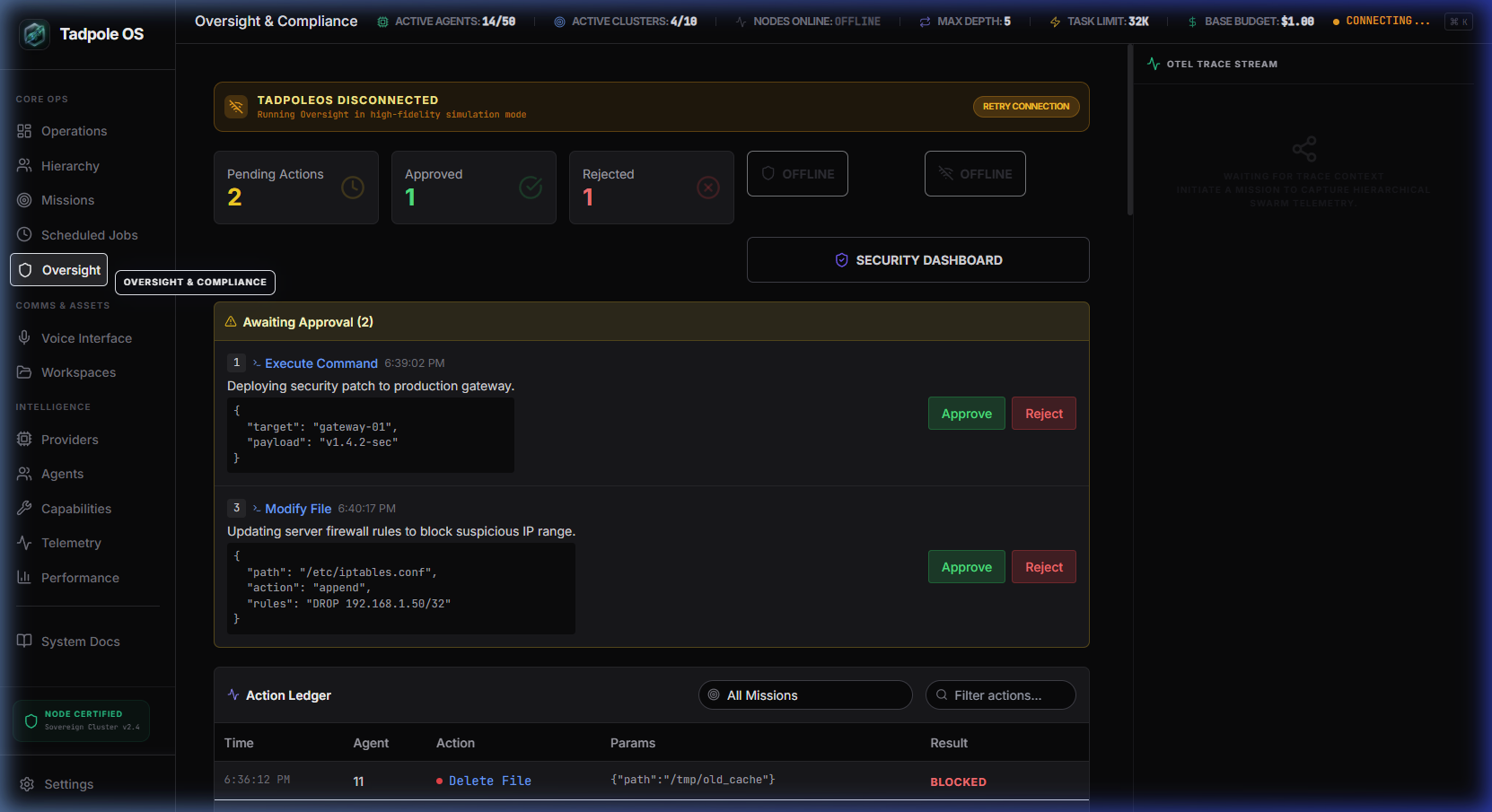
Continuous Telemetry & Human-In-The-Loop
Managers gain complete visibility over multi-agent workflows with **10Hz MessagePack telemetry streams** and WebSocket HITL gates. High-risk capabilities (`shell:execute`, `budget:spend`) are frozen until signed by management.
Sovereignty as the Ultimate Enterprise Advantage
By deploying Tadpole OS locally on hardware nodes, enterprises eliminate API vendor lock-in, protect proprietary trade secrets, and expand EBITDA margins through autonomous swarm scaling.
Transition from Manual Drudgery to Swarm Director
Operators turn routine SOPs into executable Markdown directives (`directives/`), multiplying individual output by 10x to 100x while maintaining full human oversight over execution outcomes.
Ingest playbooks, run parallel audits, and synthesize executive findings automatically.
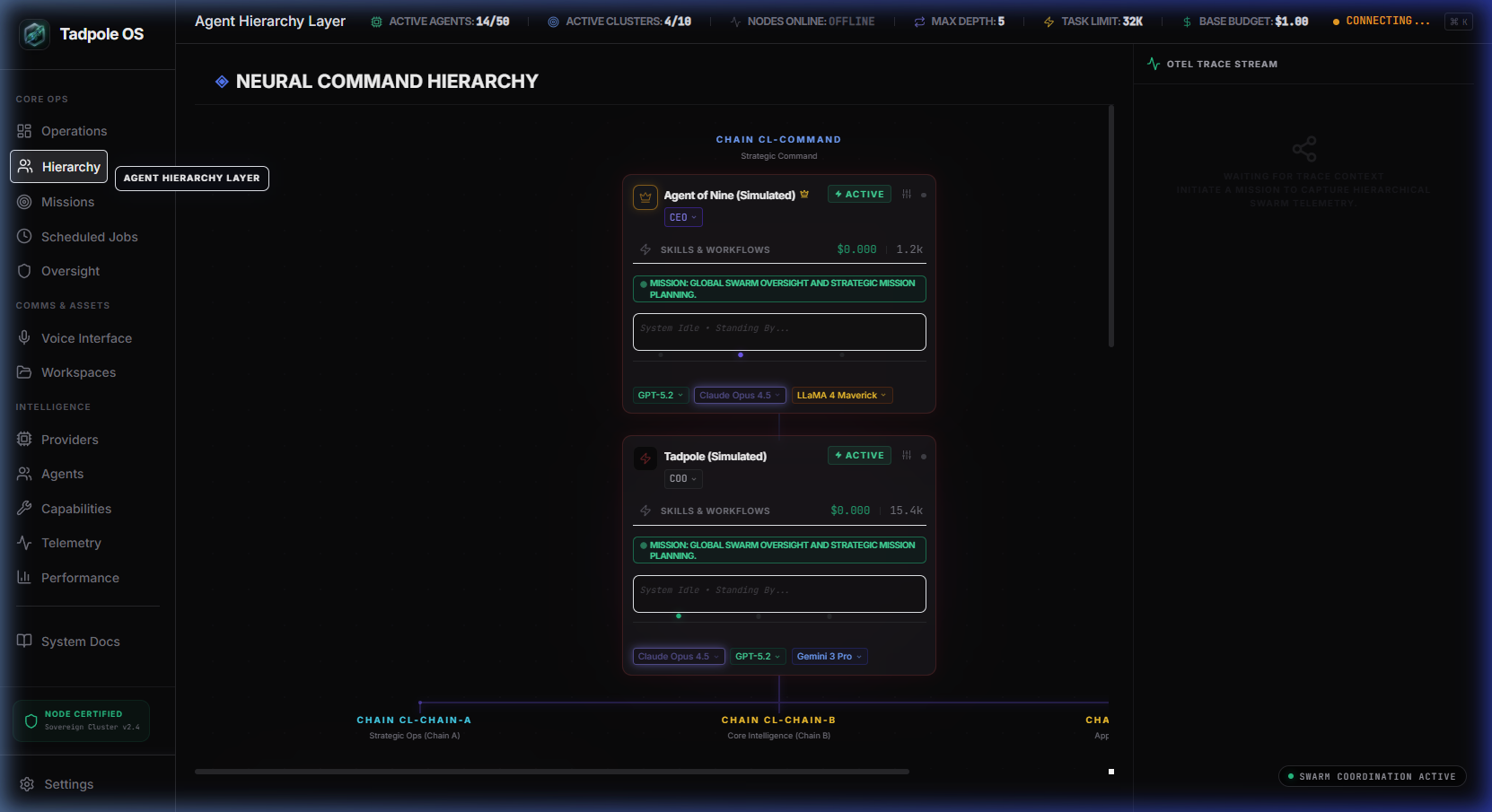
Tri-Slot Model Routing Architecture
AI-Tadpole-OS decouples model selection from application logic. The engine automatically routes prompts across three fallback slots to guarantee 100% mission uptime.
Local Ollama Engine
Local qwen2.5-coder / llama3.3 models running air-gapped on hardware GPU/NPU acceleration.
Groq Ultra-Speed LPU
Ultra-fast cloud inference fallback (500+ tokens/sec) for complex multi-agent reasoning tasks.
Google Gemini 1.5 Flash
Massive 2M token context window slot for large document ingestion & deep architectural synthesis.
Core Protocol Performance Metrics
Verified metrics across Rust `server-rs` and Tauri desktop builds.
Ready to Deploy Sovereign Swarms?
Clone the runtime repository and start building autonomous, privacy-first multi-agent systems on your own hardware.